Bell’s palsy is a sudden weakness or paralysis of the muscles on one side of the face. It happens when the facial nerve is damaged and no other cause can be found. It usually develops within hours. Most people recover fully within weeks to months, but about 3 in 10 have a longer recovery and may develop complications such as synkinesis.
If you have just been diagnosed, you probably have many questions. Will my face come back? How long will it take? What should I do now? In this guide, we explain what Bell’s palsy is, how it affects the facial nerve, and what you can expect from your recovery. We base it on what we have seen in over 18 years of working with facial palsy patients from around the world.
Key facts about Bell’s palsy
- It affects one nerve. Bell’s palsy damages only the facial nerve. Your facial muscles stay healthy.
- It is not a disease. It is an acute functional disorder of the facial nerve, closer to an injury than to an illness.
- It does not last forever. The paralysis ends when the first movements return. Most recoveries take a few weeks to a few months.
- Your facial muscles do not waste away. Muscles may look thinner and softer for a while, but they do not atrophy.
- Improvement is possible even years later. The root of the facial nerve in the brain stays alive, so the nerve can keep improving long after the paralysis.
Contents
Symptoms of Bell’s palsy
Bell’s palsy usually starts suddenly. It develops within a few hours, or at most within one or two days. You may notice:
- One side of the face drooping or not moving at all
- Difficulty closing the eye on the affected side
- A drooping mouth corner, drooling, or difficulty eating and drinking
- A dry eye, or on the contrary, excessive tearing
- Changes in taste on the front of the tongue
- Sounds feeling louder than usual on the affected side
- Pain in or behind the ear, sometimes spreading to the head, neck or shoulder
Most people feel no pain. If pain appears at the start, the damage to the nerve is often deeper and the recovery may take longer. Read more about what to do in acute Bell’s palsy.
Bell’s palsy affects the whole side of the face, including the forehead. If the forehead moves, the cause may be in the central system (the brain). Learn more about how to tell Bell’s palsy from a stroke.
What to do right away
If your face has suddenly become weak on one side, see a doctor the same day.
- Get checked urgently. A doctor needs to rule out a stroke and other causes. If you also have weakness in an arm or leg, slurred speech, or confusion, call emergency services immediately.
- Ask about steroids. Steroid treatment works best when started within 72 hours of the first symptoms. In a large review of studies [source], 17% of people treated with steroids had an incomplete recovery, compared with 28% of people who were not. Read more about prednisone and Bell’s palsy.
- Protect your eye. If your eye does not close, it can dry out. Your doctor may advise eye drops, ointment, or taping the eye at night.
- Support the nerve gently. Keep your face and neck warm and avoid strong facial exercises. Our guide to acute Bell’s palsy explains what to do, what not to do and what to expect in the first weeks.
What causes Bell’s palsy?
By definition, Bell’s palsy is the diagnosis given when doctors cannot find the exact cause of the facial palsy. Most medical reseawhrch points to a viral infection, most often a reactivation of the herpes simplex virus, which causes the nerve to swell. The facial nerve passes through a very narrow bone channel behind the ear, so even a small swelling can compress it.

In our clinic, many patients also tell us that their face was exposed to cold just before the palsy started: a cold wind, a draft, or air conditioning. Cold can narrow the blood vessels that supply the nerve with oxygen. A longer disruption of blood supply can lead to deeper damage.
Known risk factors include:
- Long-term stress, which weakens the immune system
- The last weeks of pregnancy and the first weeks after giving birth
- Diabetes and high blood pressure
When a cause can be found, the diagnosis is no longer Bell’s palsy. For example, facial palsy caused by the shingles virus is called Ramsay Hunt syndrome. Other causes include ear infections, Lyme disease, head injuries, tumours and surgery near the nerve. Read more about the causes of Bell’s palsy and the difference between facial palsy and Bell’s palsy.
How Bell’s palsy damages the facial nerve
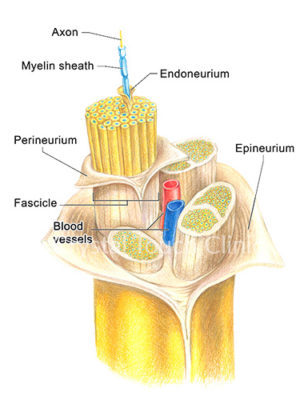
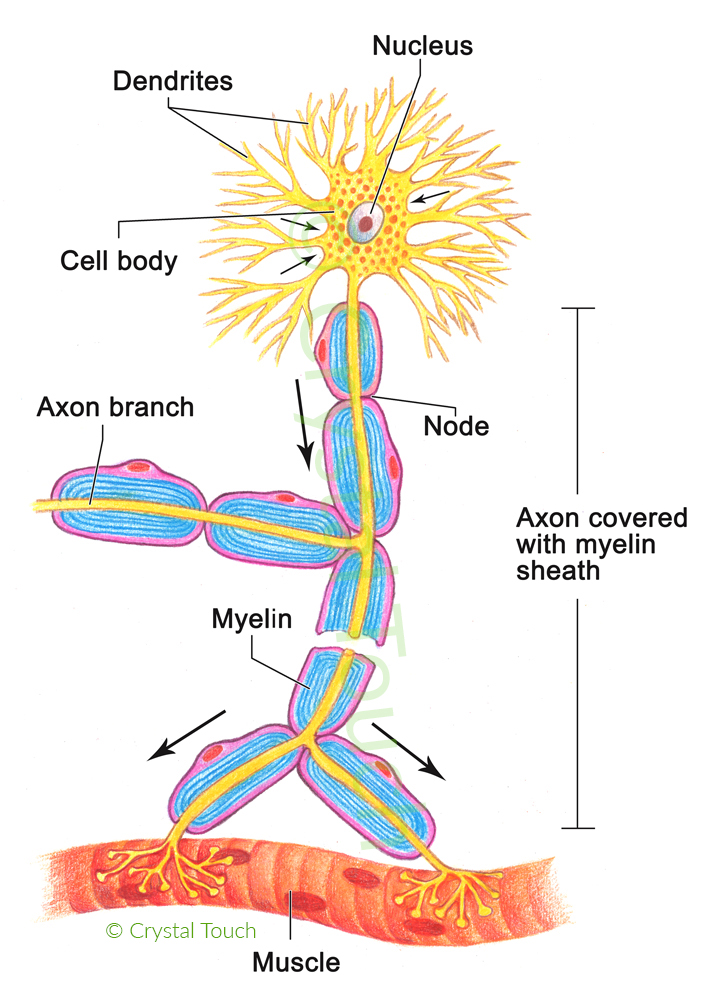
The facial nerve works like a cable made of about 7,000 thin wires, called nerve fibres. Each fibre carries signals from the brain to the facial muscles. Like an electrical wire, each fibre is wrapped in insulation, called the myelin sheath.
The nerve is usually damaged in the narrow bone channel behind the ear. The damage develops in three stages.
Stage 1: compression or reduced blood supply
In the first hours, swelling or a spasm of the blood vessels squeezes the nerve. This is when early treatment matters most.

Stage 2: loss of insulation
Within 1 to 3 days, the cells that form the myelin sheath die. Signals from the brain can no longer pass, even though the nerve fibres are still intact. This is called a conduction block, and it is why the paralysis appears so suddenly. If the damage stops here, the insulation grows back and a full recovery usually takes 3 to 5 weeks.
Stage 3: loss of the nerve fibres
If the damage lasts longer than 4 to 6 days, the nerve fibres themselves die from the point of damage to the face. The fibres then need to grow back about 9 to 10 cm, at most 1 mm per day. This is why the first movements can take up to 3 months or longer to return.
The root of the facial nerve, located in the brain, is not affected. This is why the nerve can always regenerate.
The facial nerve has five branches, which control different muscles: the forehead, the eye, the cheek and upper lip, the lower lip and chin, and the neck. The branches regenerate at different speeds, so movements do not return all at once. Often the eye closing and small mouth movements come back first, and lifting the eyebrow comes last. Learn more about the structure of the facial nerve and the facial muscles and their functions.
Is Bell’s palsy a disease?
No. Bell’s palsy is an acute functional disorder of one nerve. Diseases such as diabetes or heart disease involve the whole body and develop slowly. Bell’s palsy involves only the facial nerve and usually happens overnight.
We often compare it to a broken leg. It happens suddenly and needs time to heal. It can also heal incompletely. But you cannot have a broken leg for a lifetime: what can remain are its consequences. In the same way, Bell’s palsy itself ends once the first facial movements return. From that moment, you are in the recovery period.
How long does Bell’s palsy last?
Recovery follows one of two scenarios, depending on how deep the damage to the nerve was.
- Quick recovery (a few weeks). Only the insulation of the nerve was damaged. Movements return within about 3 to 5 weeks, usually without complications. This is the case for most people. See the quick Bell’s palsy recovery timeline.
- Long recovery (3 to 4 months or more). The nerve fibres were also damaged and need to grow back. This happens in about 3 in 10 people, more often after an infection or a long disruption of blood supply. See the long Bell’s palsy recovery timeline.
The first sign of recovery is usually not movement. The tone of the muscles returns first, so your face looks more even at rest, and you may feel twitching, tingling or itching. Read about the first signs of recovery and how to measure your recovery progress at home. For a full overview, see how long Bell’s palsy recovery takes. Remember, Bell’s palsy does not last forever.
What can remain after a long recovery
After a long recovery, some nerve fibres may reconnect to the wrong muscles or stop growing halfway. This can lead to complications that remain for months or years. They are not Bell’s palsy itself, but its after-effects:
- Synkinesis: involuntary movements, such as the eye closing when you smile or speak
- Facial asymmetry and weakness of some muscles
- Contractures and facial pain: a smaller eye, a deeper nasolabial fold, a dimpled chin
- Tension in the neck and mouth
- Stiffness and tiredness of the face, worse by the end of the day
- Crocodile tears or a lack of tears
These complications do not usually go away on their own. But in most cases, they can be reduced, even many years after the onset. Read more in Is Bell’s palsy permanent?
How we can help
Crystal Touch specializes in the late stages of recovery, from 8 months to 30+ years or more after the onset. We use our own Neuro-Proprioceptive Rehabilitation method, a non-invasive approach to reduce synkinesis, tension and asymmetry.
If you would like to understand your own situation, you can book a video consultation with Dr. Alex Pashov. He will review your recovery history, assess your current condition and explain what improvement is realistic for you.
For more articles on every stage of recovery, visit our Bell’s Palsy Knowledge Base.
Frequently asked questions about Bell’s palsy
Bell’s palsy itself is not life-threatening, but it needs to be checked by a doctor the same day, because a stroke can look similar. The main risk is to the eye: if it does not close, it can dry out and get damaged, so it needs protection until the eyelid works again.
In most cases, yes. The facial nerve regenerates on its own, and most people recover fully within weeks to a few months. Steroids started within 72 hours improve the chances. If complications remain after a long recovery, they can usually be reduced with specialized rehabilitation.
No. You cannot catch Bell’s palsy from another person. Although a virus is thought to be involved in many cases, the facial palsy develops because of swelling of your own facial nerve.
It is uncommon, but Bell’s palsy can happen again, on the same side or on the other side of the face. A repeated palsy should always be checked by a doctor, to rule out other causes.
No. The paralysis ends once the first movements return. What can remain after a long recovery are complications such as synkinesis, asymmetry and tension. These can usually be improved, even years later. Read more in Is Bell’s palsy permanent?
No. Unlike other muscles, facial muscles stay connected to the brain through a second nerve, the trigeminal nerve, which keeps them alive. They may look thinner because of lost tone, but this improves when the facial nerve reconnects. Read more about atrophy after Bell’s palsy.
Yes, many people feel tired. Your brain works harder to control the face, and the muscles on the healthy side do extra work. Stress and poor sleep add to it. Read more about why the face feels stiff and tired.
Only a doctor can confirm it. One important difference is the forehead: Bell’s palsy usually affects the whole side of the face, including the forehead, while a stroke often spares it. A stroke can also cause weakness in an arm or leg and slurred speech. See Bell’s palsy vs stroke.