Key Takeaways
- The first sign of recovery after Bell’s palsy is not facial movement but increased facial muscle tonus.
- Tonus returns weeks before movements, making the affected side less droopy and more symmetrical.
- Patients may also notice sensations like vibration and twitching as recovery progresses.
- Avoid checking the mirror frequently; it can create negative emotions and hinder recovery.
- Document your progress weekly through photos to better track changes during recovery.
Contrary to the popular belief, the return of your facial movements is not the first sign of your recovery. A few weeks before that, you will notice something else happening to your face.
Recovery after any peripheral facial palsy, such as Bell’s palsy, Ramsay Hunt Syndrome, and other, may sometimes take a long time. It can last from a few weeks to 3 or 4 months. In severe cases, the recovery can take even longer. Although first movements are a sure tell signs of recovery, you can notice that your face is changing even before that.
Contents
Tonus of facial muscles returns before your facial movements
Several weeks before your facial movements return, you will notice that your face is becoming more symmetric at rest. The affected side will become less droopy and will appear more full. Your mouth corner may appear to be going back up a little from hanging down. Your eye from being wide open may start looking more closed.
This happens because the tonus of your facial muscles returns even before your facial nerve reconnects with facial muscles. The explanation of why the tonus returns before the movements, we will cover in another article in the future, as it needs detailed explanations of anatomy and facial nerve recovery.
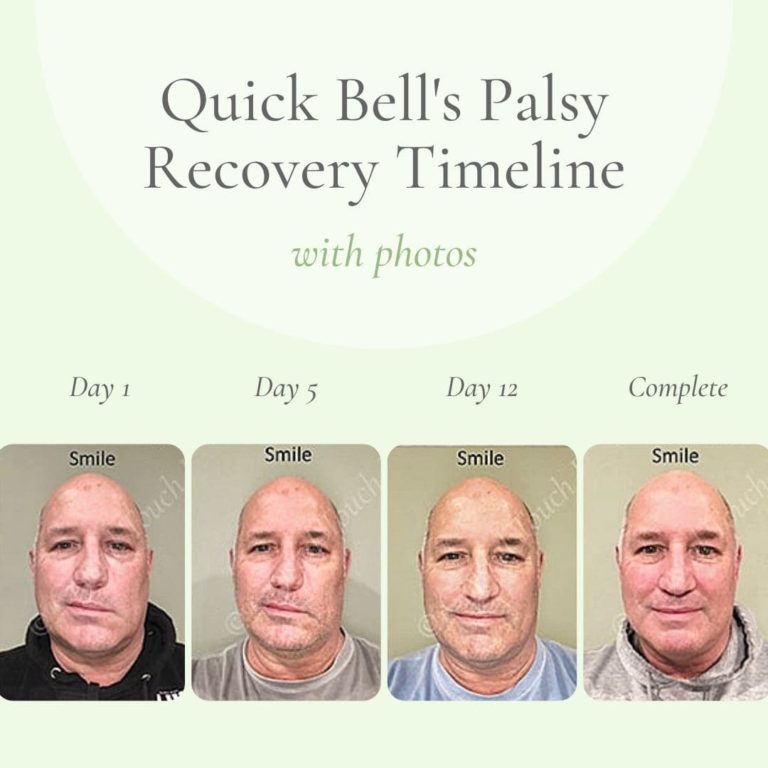
Take a look at this example from Jay’s Bell’s palsy recovery process. On the first picture, you can see three facial expressions on day 1 of his Bell’s palsy. On the 2nd image under, you can see the same facial expressions some time later, when the facial nerve began approaching its reconnection with the facial muscles.


This change might be barely noticeable. In Jay’s case, his recovery was rather quick (it took a few weeks until full recovery), so the tonus returned within the first 7 days. His movements began to appear within a week after that. If your recovery is longer and needs at least a few months, you may notice the return of tonus a few weeks before your first facial movements.
The first facial movements that follow the return of tonus may include little movements of your mouth corner, your eye may start closing more, or you may notice movements in your eyebrow. Little by little, other muscles will begin to move.
Other signs of upcoming recovery
Together with the return of tonus, you may notice some feelings of vibration, itching, twitching. These feelings usually accompany the first facial movements, or may appear in between the return of tonus and first movements.
Keep visual progress to see the first sign of your facial palsy recovery
The return of tonus might be very easy to miss, especially when your recovery has been going on for several months.
One of the best ways to notice it, is to make Neurological Tests once per week. Comparing these tests every week will help you see when your facial tonus is beginning to return. Soon after that, you can expect to see first movements appearing.
Why to avoid checking the mirror
When the first sensations return, it is tempting to check your face in the mirror every day. In our rehabilitation method, we advise against it, for two reasons.
- It brings negative emotions. Most people do not like what they see in the mirror during recovery: the asymmetry, the unwanted movements. Negative emotions and stress slow down the body’s natural ability to heal.
- It cannot show what matters. A mirror only shows visible movement. When muscles work against each other without moving the face, you cannot see it, yet you are still training that pattern. Synkinesis is a learned pattern, so the more you repeat it, the longer it takes to unlearn.
Instead, we teach our patients to use an “internal mirror”: close your eyes and feel what your face is doing, which muscles contract and which relax. Little by little, you learn to sense your face again. This is the basis of our Neuro-Proprioceptive Rehabilitation method.
To track your progress without daily mirror checks, record the same photos once a week, as described in measuring your recovery at home.
Remember to be patient
Facial nerve needs time to recover. Depending on the damage, it can take between a few weeks to several months, until the first movements appear. It cannot recover faster than the laws of nature permit.
Be kind and gentle to your face during the recovery and support your body with healthy lifestyle and rest.
If you need any help, advice or guidance, please contact us. We will help you to the best of our abilities.
Contrary to popular belief, the return of facial movement is not the first sign of recovery. Before visible movements return, you may notice the return of muscle tone on the affected side, the face starts feeling less “droopy” and more supported, even before you can actively move it.
The first signs of returning muscle tone can appear within a few weeks after onset if you are on the quick recovery path. If recovery is taking longer, these early signs may appear later. The timeline varies significantly from person to person based on the severity of nerve damage.
The return of muscle tone is a positive sign, but it does not guarantee full recovery without complications. If the recovery takes longer than 3 to 4 weeks, there is a higher likelihood of developing synkinesis and other residuals. Monitoring your progress with weekly neurological tests is important.